
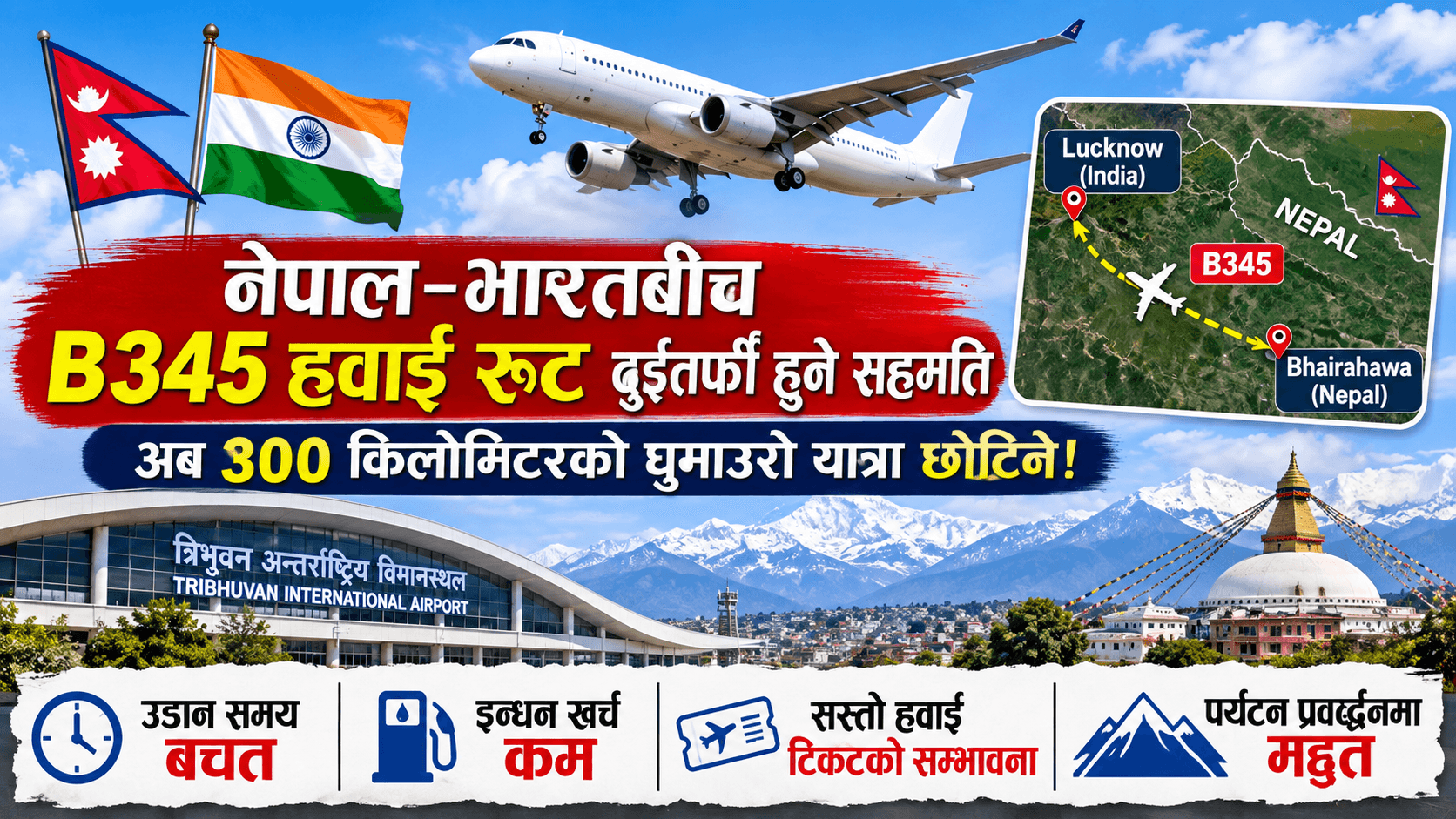
KATHMANDU, Nepal — Nepal and India have agreed to make the existing Kathmandu–Bhairahawa–Lucknow (B345) air route operational in both directions, marking a significant breakthrough in Nepal’s long-standing efforts to expand international air connectivity.
The agreement was included in the joint statement issued on November 23 following the official visit of Nepal’s Prime Minister to India. The two countries agreed to convert the currently one-way route into a bidirectional air corridor, allowing aircraft to use it for both entry into and departure from Nepal.
The development is being viewed as an important step towards strengthening Nepal’s aviation sector, improving international connectivity and facilitating the operation of Gautam Buddha International Airport in Bhairahawa and Pokhara International Airport.
Nepal had been seeking additional international air entry routes from India since 2009. After nearly 17 years of diplomatic and technical discussions, the latest agreement has raised hopes for a more efficient and accessible aviation network.
300-Kilometre Detour Expected to Be Reduced
At present, international aircraft approaching Bhairahawa from the western side cannot enter Nepal directly through the Bhairahawa route. Instead, they must fly eastward towards Simara before turning back west to land at Bhairahawa.
This arrangement forces aircraft to cover approximately 300 kilometres of additional distance, increasing flight time, fuel consumption and operating costs.
Once the B345 route becomes operational in both directions, aircraft arriving from the west are expected to gain more direct access to Bhairahawa, eliminating the need for the lengthy detour.
The change could significantly improve the operational efficiency of international flights serving Nepal’s western region.
According to tourism-related government documents, international flights approaching Pokhara from the west also face an additional distance of approximately 185 kilometres under the current air-entry arrangements.
Potential Relief in Flight Time and Operating Costs
A shorter flight route is expected to reduce travel time, fuel consumption and overall airline operating expenses.
Lower operating costs could improve the commercial viability of international flights to regional airports and encourage airlines to consider expanding their services.
Passengers may also benefit from more competitive airfares in the future. However, a reduction in ticket prices is not guaranteed, as fares depend on airline policies, market competition and other operational expenses.
Technical Procedures Still Pending
Although the bilateral agreement has been reached, the route cannot immediately come into regular operation. Several technical and operational arrangements must first be finalised by the civil aviation authorities of both countries.
One of the major issues is the flight altitude that aircraft will be permitted to maintain while passing through Indian airspace before entering Nepal and approaching Bhairahawa.
Because Gautam Buddha International Airport is located close to the Indian border, aircraft need to descend to a suitable altitude before landing. The permitted altitude and other air traffic management arrangements will therefore be crucial to the successful implementation of the route.
Technical consultations between the two countries are expected to determine the operational procedures and safety requirements.
Following the completion of these arrangements, the revised route will be incorporated into the relevant aviation information and navigation charts before regular operations begin.
Positive Outlook for Tourism and Regional Airports
The two-way operation of the B345 route is expected to improve international access to Gautam Buddha International Airport and support the development of Pokhara International Airport.
Improved air connectivity could benefit tourism destinations such as Lumbini, Pokhara and other parts of western Nepal by making international travel more convenient.
The route may also help ease pressure on Tribhuvan International Airport in Kathmandu by providing better access to Nepal’s regional international airports.
For Nepal’s aviation and tourism industries, the agreement represents an important opportunity to strengthen regional connectivity, attract more international flights and improve the country's position as a tourism destination.
A Significant Step, With Implementation Yet to Come
The agreement to make the Kathmandu–Bhairahawa–Lucknow air route bidirectional is a major achievement in Nepal’s efforts to expand its international air access.
However, its full benefits will depend on the completion of technical consultations, the finalisation of flight-altitude arrangements and the commencement of regular operations.
Once implemented, the route could reduce unnecessary flight distances, lower airline operating costs and provide a stronger foundation for the growth of international aviation and tourism in Nepal.