
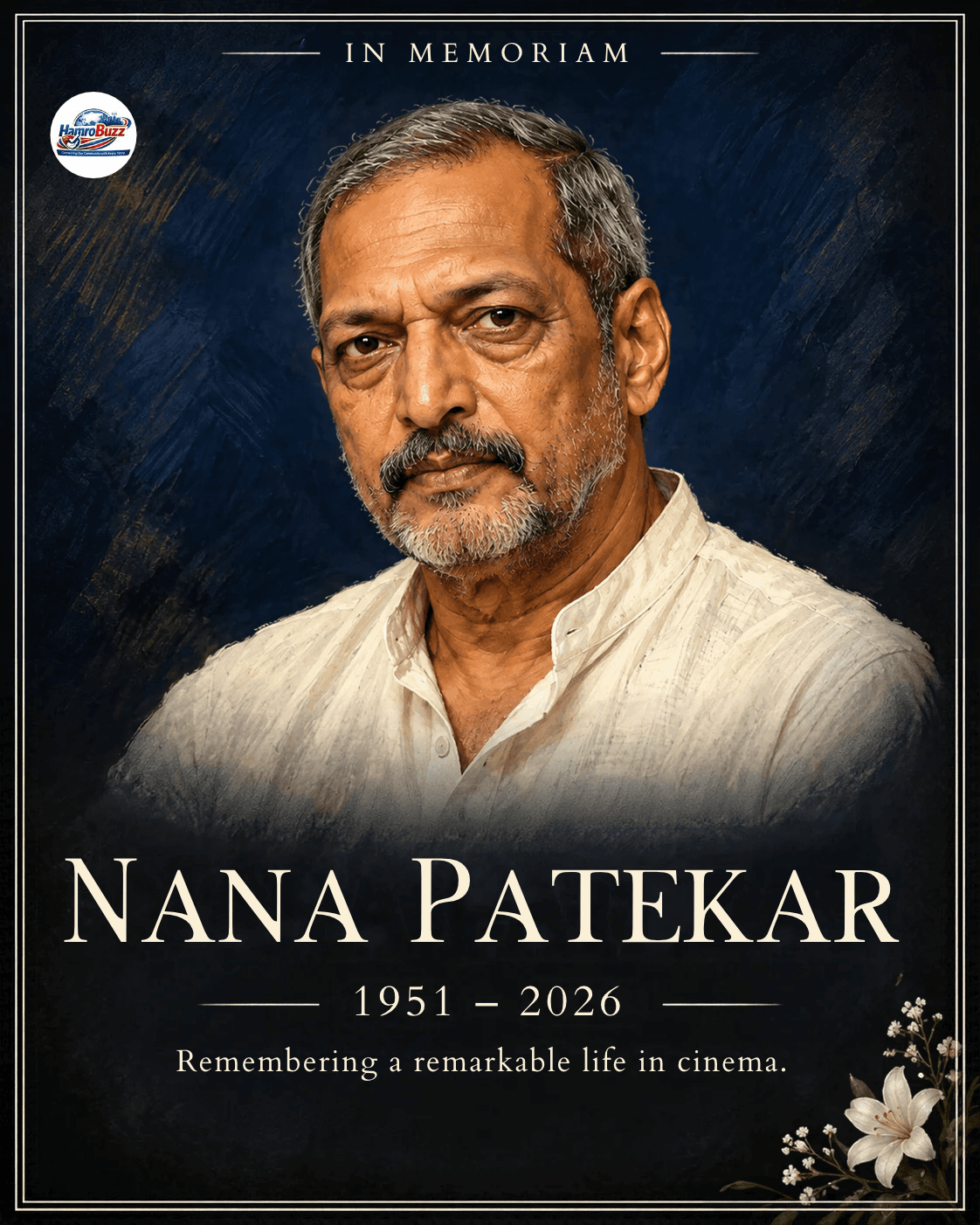
Acclaimed Indian actor and filmmaker Nana Patekar, widely celebrated for his fierce screen presence and morally complex portrayals across five decades of Hindi and Marathi cinema, died in Goa on October 8, 2026. He was 75 years old.
According to attending medical authorities, Patekar became critically unwell at his private residence in Goa during the early hours of Thursday, October 8. He was rushed to Manipal Hospital in Dona Paula, where emergency clinicians attempted resuscitation before pronouncing him dead. Late Thursday night, the veteran artist was cremated with full state honours at his farmhouse on the outskirts of Pune, Maharashtra.
A. What has been confirmed
The precise sequence of events began in the pre-dawn hours of Thursday, October 8, 2026. Patekar reportedly sent a mobile message to a personal acquaintance at approximately 2:30 AM IST stating that he was feeling physically uncomfortable. The friend discovered the message later and arrived at Patekar’s residence around 4:00 AM IST, finding the actor heavily sweating and gasping for breath.
A caretaker alerted Manipal Hospital in Goa, whose emergency medical crew arrived by ambulance and initiated cardiopulmonary resuscitation (CPR) inside the residence after finding him unresponsive. The actor was transported under continuous resuscitation to the hospital at approximately 4:20 AM IST. Despite extended resuscitative efforts lasting roughly 45 to 60 minutes, he could not be revived and was pronounced dead at approximately 5:20 AM IST.
Medical specifics were formally detailed by Dr. Shekhar Salkar, Chief of the Department of Oncology at Manipal Hospital, Goa. Briefing reporters, Dr. Salkar confirmed that while Patekar suffered a fatal cardiac arrest, the underlying clinical cause could not be determined at admission. Hospital records did not indicate whether the actor had a known prior history of coronary artery disease or was taking regular cardiac medication. Because Patekar was brought in an unresponsive state, the hospital filed a standard medico-legal notification with local police, and his body was transferred to Goa Medical College (GMC), Bambolim, for a post-mortem examination.
His son, Malhar Patekar, confirmed the passing to media outlets upon travelling from Pune to Goa, initially characterizing his father’s death as natural causes before procedural examinations concluded.
"Nana Patekar was brought unresponsive to our hospital around 4:20 AM. Our emergency team started cardiac massage at his residence and continued CPR at the hospital for nearly 45 minutes to an hour, but he could not be revived. It is a case of cardiac arrest, but whether there was a pre-existing cardiac history, we cannot confirm without the post-mortem report." — Dr. Shekhar Salkar, Manipal Hospital, Goa
B. Latest funeral and family updates
Following the completion of procedural post-mortem formalities in Goa, Patekar’s mortal remains were flown to Pune Airport on Thursday afternoon, where Maharashtra Chief Minister Devendra Fadnavis paid formal respects on the tarmac. In accordance with the actor’s explicit personal wishes, the funeral rites were held at his agricultural farmhouse in Donje village, situated along the Sinhagad foothills on the outskirts of Pune.
Maharashtra Cultural Affairs Minister Ashish Shelar announced that the state cabinet had resolved to accord Patekar a full state funeral in recognition of his unparalleled cultural stature in Marathi theatre and nationwide cinema. The actor’s casket was draped in the Indian Tricolour and escorted to the funeral pyre after 10:30 PM IST by a ceremonial police band. A ceremonial 21-gun salute was executed by female police officers of the Maharashtra Police force.
The final rites and lighting of the funeral pyre were performed late Thursday night by his son, Malhar Patekar. An estimated gathering of over one thousand mourners stood in attendance under heavy police security, including Maharashtra Deputy Chief Ministers Eknath Shinde and Sunetra Pawar, Union Ministers Ramdas Athawale and Murlidhar Mohol, state cabinet ministers, and prominent Marathi film personalities including Pravin Tarde and Kiran Yadnyopavit.
C. A career across Hindi and Marathi cinema
Born Vishwanath Patekar on January 1, 1951, in Murud, coastal Maharashtra, he graduated from Mumbai’s prestigious Sir J.J. Institute of Applied Art before finding his true calling in Mumbai’s Marathi experimental theatre scene. He made his feature film debut in Muzaffar Ali’s 1978 Hindi drama Gaman, slowly building a reputation through sharp, unvarnished dramatic turns in Ankush (1986) and Mira Nair’s Oscar-nominated 1988 classic Salaam Bombay!.
Patekar’s mainstream breakthrough came in Vidhu Vinod Chopra’s 1989 underworld milestone Parinda, where his volatile depiction of Mumbai crime boss Anna Seth fetched him the National Film Award for Best Supporting Actor. In 1991, he directed and starred in Prahaar: The Final Attack, an intense military drama for which he underwent rigorous commando training with the Indian Army’s Maratha Light Infantry — a military affiliation that later earned him the honorary rank of Lieutenant Colonel in the Territorial Army.
Throughout the 1990s, Patekar redefined dramatic dialogue delivery in Indian commercial cinema. In Mehul Kumar’s Krantiveer (1994), his depiction of the disillusioned, impassioned reformer Pratap Narayan Tilak earned him both the National Film Award for Best Actor and the Filmfare Best Actor trophy. He followed it with another National Film Award for Best Supporting Actor in Agni Sakshi (1996), showcased understated pathos as a deaf-mute father in Sanjay Leela Bhansali’s Khamoshi: The Musical (1996), and portrayed real-life encounter specialist Sadhu Agashe in Shimit Amin’s gritty crime procedural Ab Tak Chhappan (2004).
Remarkably versatile, Patekar transformed his intense persona into box-office comedy gold as the lovelorn mobster Uday Shetty in Anees Bazmee’s smash hit Welcome (2007) and its 2015 sequel. Yet his crowning artistic achievement arrived in Marathi cinema with Mahesh Manjrekar’s 2016 tragedy Natsamrat, based on V.V. Shirwadkar’s celebrated play. Patekar’s heartbreaking portrayal of the aging, destitute Shakespearean stage actor Ganpat Ramchandra Belwalkar is widely regarded as one of the finest acting masterclasses in modern Indian cinematic history. He later made an indelible Tamil cinema appearance playing political antagonist Harinath Desai opposite Rajinikanth in Pa. Ranjith’s Kaala (2018).
D. Tributes and remembrance
Condolences across the subcontinent recognized both his creative depth and his moral conscience. Prime Minister Narendra Modi expressed profound sorrow, commending Patekar’s singular artistic footprint:
"Pained by the passing of acclaimed actor Nana Patekar Ji. He enriched Indian cinema and theatre with his unmatched intensity, individuality and unmistakable presence. My thoughts are with his family and countless admirers." — Narendra Modi, Prime Minister of India
Maharashtra Chief Minister Devendra Fadnavis praised the actor’s profound societal commitment alongside his cinematic brilliance:
"Nana was as great-hearted as he was great on screen. He gave Marathi and Hindi cinema an entire era. From Krantiveer to Natsamrat, there is no parallel to the powerful range of his acting. His passing leaves an irreplaceable void in our cultural fabric." — Devendra Fadnavis, Chief Minister of Maharashtra
Goa Chief Minister Pramod Sawant also mourned the veteran actor, highlighting his close bond with the coastal state and his remarkable cross-disciplinary journey across regional theatre and Indian cinema.
E. His contribution to cinema and society
In 2013, the Government of India conferred upon Patekar the Padma Shri, the nation’s fourth-highest civilian honour, recognizing his exemplary contribution to the performing arts. Yet Patekar’s enduring legacy among common citizens reached far beyond movie theatres.
Deeply moved by the severe agrarian crisis and farmer suicides in Marathwada and Vidarbha, Patekar co-founded the non-profit Naam Foundation in September 2015 alongside Marathi actor Makarand Anaspure. Operating with transparent public audits, the foundation raised hundreds of millions of rupees to finance river-widening, desilting initiatives, farm pond construction, and direct financial grants to widows of impoverished farmers. Rather than retiring into cinematic nostalgia, Patekar spent substantial weeks each year on the ground inspecting water conservation channels in rural villages.
Patekar leaves behind an indelible body of work characterized by blistering emotional conviction, fierce social criticism, and an enduring humanitarian commitment that bridged the worlds of art and civic duty.
Source Documentation & Reporting Verification: The Indian Express — Initial medical timeline and on-the-record interview with Dr. Shekhar Salkar (Published Oct 8, 2026). The Indian Express — Pune funeral rites, 21-gun salute, and state honour coverage (Published Oct 8–9, 2026). India Today — Hospital emergency log, career retrospective, and October 4 public speech in Goa (Published Oct 8, 2026). Al Jazeera — International news desk wire synthesis quoting PTI and Malhar Patekar (Published Oct 8, 2026).