Myagdi, November 28. Farmlands that once produced rice, millet, maize and wheat in Surkemela, Benі Municipality–4 of Myagdi, have now been transformed into orange orchards. Farmers who shifted from traditional food crops to commercial orange cultivation have experienced significant changes in their income and lifestyles.
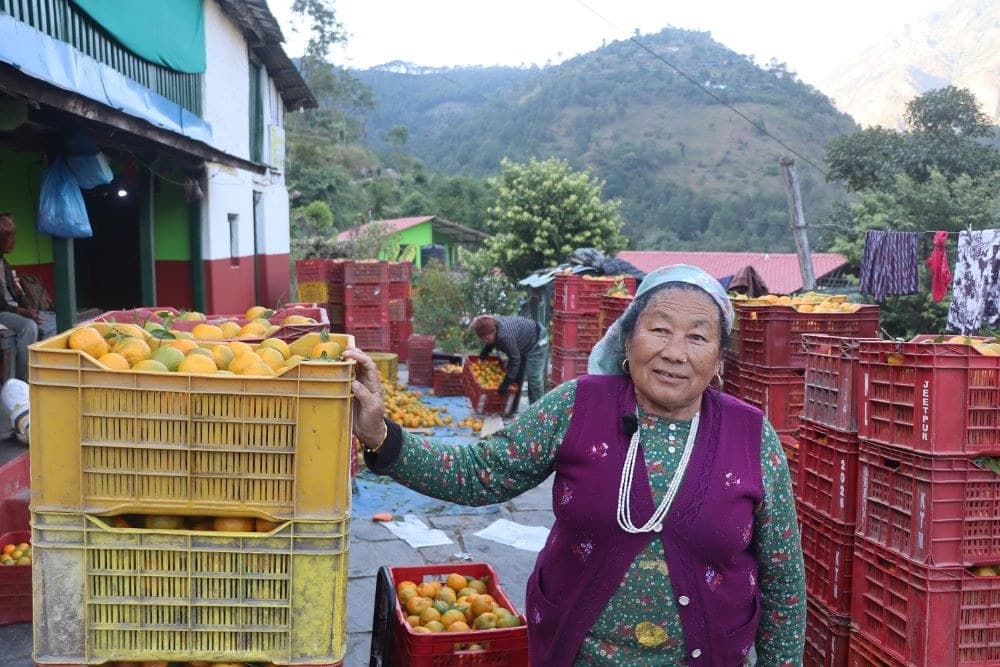
Sixty-five-year-old Balkumari Roka of Surkemela planted orange saplings in a field that previously produced seven muri of rice 14 years ago. She began orange farming in 2069 BS as an alternative to traditional crops due to a shortage of agricultural labour.
Today, her orchard has 250 orange trees generating an annual income of around Rs. 700,000. According to Roka, orange farming provides better returns with less labour compared to traditional food crops.
“An orchard planted in a field that once produced seven muri of rice now earns around Rs. 700,000 a year,” she said. “Even though my children have gone abroad, I enjoy working in orange farming.”
Another farmer, Dropati Thapa, has also increased her income through orange cultivation. She sold oranges worth Rs. 150,000 last year and expects sales to reach around Rs. 300,000 this year, as more trees have begun producing fruit and the harvest has improved.
Forty-six-year-old Dil Bahadur KC was the first farmer in Surkemela to expand commercial orange farming. He planted orange saplings 15 years ago on farmland he received through inheritance. At the time, relatives and neighbours criticised his decision to replace rice cultivation with orange trees.
“They scolded me, saying I was planting thorny trees in a rice field and would leave my children hungry,” KC recalled. “Now, those who criticised me are amazed to see the income I earn from selling oranges.”
KC has planted 450 orange trees across 20 ropanis of farmland and sold oranges worth more than Rs. 1.5 million this year. After working in the United Arab Emirates and Malaysia for five years, he returned to Nepal and also established the KC Beekeeping Resource Centre alongside his orange farming business.
According to KC, 16 farmers in Surkemela are now engaged in commercial orange cultivation. Dhanraj Pun, who has planted 400 orange trees, said orange farming generates significantly higher income than traditional crops. He estimates that farmland previously producing eight to ten muri of rice can now generate more than Rs. 1 million annually through orange cultivation.
The income from orange farming has enabled some local farmers to purchase houses and land in Pokhara, Beni and Baglung. They have also been able to provide better education for their children in schools and colleges.
Surkemela is considered suitable for orange farming because of its irrigation facilities, favourable geography and climate. Oranges produced in the area are juicy and flavourful, attracting traders from Kathmandu, Pokhara and Beni, who purchase the fruit directly from orchards.
Surkemela is among the earliest areas in Myagdi to harvest oranges. The fruit ripens early and develops an attractive colour and taste, allowing orchards to be cleared by the second week of Mangsir.
Improved road access and reliable markets have encouraged farmers to expand orange cultivation to additional areas.
The Agriculture Knowledge Centre and Beni Municipality have also supported the expansion of commercial orange farming by distributing subsidised saplings, providing technical training and supplying agricultural tools. The construction of the Balamkhola irrigation project has further improved irrigation facilities.
According to Ward Chairperson of Beni Municipality–4, An Bahadur Khadka (Bhagwan), commercial orange farming has also expanded in Baskuna and Thamdanda.
A road improvement project connecting Dukhkhola, Surkemela, Baskuna, Thamdanda and Marek is scheduled to begin this year. The project will run for three years through a cost-sharing arrangement between Gandaki Province Government and Beni Municipality.
The current fiscal year has allocated Rs. 16 million for the project, with a total budget of Rs. 50 million secured over three years. The contract process is underway, Khadka said.
A detailed project report has also been prepared for a road bridge connecting Surkemela and Singa and submitted to the federal government.
For farmers who turned to alternatives after traditional crops failed to provide sufficient income, orange farming has become a reliable source of livelihood. Farmland that was once at risk of being abandoned is now covered with productive orange trees.
However, the growing attraction of foreign employment among young people has created a shortage of agricultural labour, posing a challenge to farmers in Surkemela.